Biogas Production Process Pdf
- Electronic versions of the handbook can be downloaded as pdf files from. Does biogas production fit in with the idea of. For biogas to form.
- GUIDE TO BIOGAS FROM PRODUCTION TO USE with support of the Federal Ministry of Food, Agriculture and Consumer Publisher. 3.2 Process engineering.
- Biogas Production Process Pdf
- Proposal Letter Of Biogas Production Process
- Biogas Production Process Steps Pdf
. Biogas typically refers to a mixture of different produced by the breakdown of in the absence of oxygen.
Pretreatment of feedstock for enhanced biogas. Pretreatment of feedstock for enhanced biogas production. Polymer which slows down the breakdown process.
Biogas can be produced from raw materials such as agricultural waste,. Biogas is a source.
Biogas can be produced by with, which digest material inside a closed system, or of biodegradable materials. Biogas is primarily ( CH 4) and (CO 2) and may have small amounts of ( H 2S), moisture and.
The gases, and ( CO) can be combusted or oxidized with oxygen. This energy release allows biogas to be used as a fuel; it can be used for any heating purpose, such as cooking.
It can also be used in a gas engine to convert the energy in the gas into electricity and heat. Biogas can be compressed, the same way as is compressed to, and used to power.
In the, for example, biogas is estimated to have the potential to replace around 17% of vehicle fuel. It qualifies for renewable in some parts of the world.
Biogas can be cleaned and upgraded to natural gas standards, when it becomes bio-methane. Biogas is considered to be a renewable resource because its production-and-use cycle is continuous, and it generates no net carbon dioxide. Organic material grows, is converted and used and then regrows in a continually repeating cycle. From a carbon perspective, as much carbon dioxide is absorbed from the atmosphere in the growth of the primary bio-resource as is released when the material is ultimately converted to energy. Main article: The biogas is a renewable energy that can be used for heating, electricity, and many other operations that use a reciprocating internal combustion engine, such as or gas engines. To provide these internal combustion engines with biogas having ample gas pressure to optimize combustion, within the European Union centrifugal units built in accordance with the European directive (previously 94/9/EG) are obligatory. These centrifugal fan units, for example, Meidinger AG or Witt & Sohn AG are suitable for use in.
Other internal combustion engines such as gas turbines are suitable for the conversion of biogas into both electricity and heat. The digestate is the remaining inorganic matter that was not transformed into biogas. It can be used as an agricultural fertiliser.
Biogas production in rural Germany Biogas is produced either;. as (LFG), which is produced by the breakdown of inside a landfill due to chemical reactions and microbes, or. as digested gas, produced inside an. Projects such NANOCLEAN are nowadays developing new ways to produce biogas more efficiently, using iron oxide nanoparticles in the processes of organic waste treatment.
Biogas Production Process Pdf
This process can triple the production of biogas. Biogas plants A biogas plant is the name often given to an that treats farm wastes or energy crops. It can be produced using anaerobic digesters (air-tight tanks with different configurations).
Proposal Letter Of Biogas Production Process
These plants can be fed with energy crops such as maize or including sewage sludge and food waste. During the process, the micro-organisms transform biomass waste into biogas (mainly methane and carbon dioxide) and. Key processes There are two key processes: and digestion which is dependent on temperature. In experimental work at, a 1000-litre digester using harvested from 'mud from a frozen lake in Alaska' has produced 200–300 liters of methane per day, about 20%–30% of the output from digesters in warmer climates.
Dangers The air pollution produced by biogas is similar to that of, but with an additional risk from the toxicity of its fraction and any unburned methane that escapes is a potent and long lived greenhouse gas. Biogas can be explosive when mixed in the ratio of one part biogas to 8-20 parts air. Special safety precautions have to be taken for entering an empty biogas digester for maintenance work. It is important that a biogas system never has negative pressure as this could cause an explosion.
Negative gas pressure can occur if too much gas is removed or leaked; Because of this biogas should not be used at pressures below one column inch of water, measured by a pressure gauge. Frequent smell checks must be performed on a biogas system. If biogas is smelled anywhere windows and doors should be opened immediately. If there is a fire the gas should be shut off at the gate valve of the biogas system. Landfill gas.
Main article: Landfill gas is produced by wet organic waste decomposing under anaerobic conditions in a biogas. The waste is covered and mechanically compressed by the weight of the material that is deposited above.
This material prevents oxygen exposure thus allowing anaerobic microbes to thrive. Biogas builds up and is slowly released into the atmosphere if the site has not been engineered to capture the gas. Landfill gas released in an uncontrolled way can be hazardous since it can become explosive when it escapes from the landfill and mixes with oxygen. The lower explosive limit is 5% methane and the upper is 15% methane. The methane in biogas is 20 times more potent a than carbon dioxide. Therefore, uncontained landfill gas, which escapes into the atmosphere may significantly contribute to the effects of. In addition, (VOCs) in landfill gas contribute to the formation of.
Technical (BOD) is a measure of the amount of oxygen required by aerobic micro-organisms to decompose the organic matter in a sample of material being used in the biodigester as well as the BOD for the liquid discharge allows for the calculation of the daily energy output from a biodigester. Another term related to biodigesters is effluent dirtiness, which tells how much organic material there is per unit of biogas source. Typical units for this measure are in mg BOD/litre. As an example, effluent dirtiness can range between 800–1200 mg BOD/litre in Panama. From 1 kg of decommissioned kitchen bio-waste, 0.45 m³ of biogas can be obtained. The price for collecting biological waste from households is approximately €70 per ton. Composition Typical composition of biogas% CH 4 50–75 CO 2 25–50 N 2 0–10 H 2 0–1 H 2S 0.1 –0.5 O 2 0–0.5 Source: www.kolumbus.fi, 2007 The composition of biogas varies depending upon the substrate composition, as well as the conditions within the anaerobic reactor (temperature, pH, and substrate concentration).
Typically has methane concentrations around 50%. Advanced waste treatment technologies can produce biogas with 55%–75% methane, which for reactors with free liquids can be increased to 80%-90% methane using gas purification techniques. As produced, biogas contains water vapor.
The fractional volume of water vapor is a function of biogas temperature; correction of measured gas volume for water vapor content and thermal expansion is easily done via simple mathematics which yields the standardized volume of dry biogas. In some cases, biogas contains. They are formed from the of materials commonly found in soaps and detergents. During combustion of biogas containing siloxanes, is released and can combine with free oxygen or other elements in the. Deposits are formed containing mostly ( SiO 2) or ( Si xO y) and can contain,.
Such white mineral deposits accumulate to a surface thickness of several millimeters and must be removed by chemical or mechanical means. Practical and cost-effective technologies to remove siloxanes and other biogas contaminants are available.
For 1000 kg (wet weight) of input to a typical biodigester, total solids may be 30% of the wet weight while may be 90% of the total solids. Protein would be 20% of the volatile solids, carbohydrates would be 70% of the volatile solids, and finally fats would be 10% of the volatile solids. Benefits of manure derived biogas High levels of are produced when manure is stored under anaerobic conditions.
During storage and when manure has been applied to the land, is also produced as a byproduct of the denitrification process. Nitrous oxide ( N2O) is 320 times more aggressive as a greenhouse gas than carbon dioxide and methane 25 times more than carbon dioxide.
By converting cow manure into methane biogas via, the millions of cattle in the United States would be able to produce 100 billion kiloWatt hours of electricity, enough to power millions of homes across the United States. In fact, one cow can produce enough manure in one day to generate 3 kiloWatt hours of electricity; only 2.4 kiloWatt hours of electricity are needed to power a single 100-Watt light bulb for one day.
Geoexpress view crack. Many downloads like Lizardtech Geoexpress V9.5.2 may also include a serial number, cd key or keygen. If this is the case it is usually included in the full crack download archive itself. Your search term for Lizardtech Geoexpress V9.5.2 will return more accurate download results if you exclude using keywords like: crack, serial, activation, code, download, keygen, etc. Otherwise you can try the serial site linked below.
Furthermore, by converting cattle manure into methane biogas instead of letting it decompose, global warming gases could be reduced by 99 million metric tons or 4%. Applications.
A biogas bus in Biogas can be used for electricity production on sewage works, in a, where the from the engine is conveniently used for heating the digester; cooking; space heating;; and process heating. If compressed, it can replace for use in vehicles, where it can fuel an or and is a much more effective displacer of carbon dioxide than the normal use in on-site CHP plants. Biogas upgrading Raw biogas produced from digestion is roughly 60% methane and 29% CO 2 with trace elements of H 2S: inadequate for use in machinery. The corrosive nature of H 2S alone is enough to destroy the mechanisms. Methane in biogas can be concentrated via a to the same standards as fossil, which itself has to go through a cleaning process, and becomes biomethane.
If the local gas network allows, the producer of the biogas may use their distribution networks. Gas must be very clean to reach pipeline quality and must be of the correct composition for the distribution network to accept., and must be removed if present.
There are four main methods of upgrading: water washing, pressure swing absorption, selexol absorption, and. In addition to these, the use of membrane separation technology for biogas upgrading is increasing, and there are already several plants operating in Europe and USA. The most prevalent method is water washing where high pressure gas flows into a column where the carbon dioxide and other trace elements are scrubbed by cascading water running counter-flow to the gas. This arrangement could deliver 98% methane with manufacturers guaranteeing maximum 2% methane loss in the system.
It takes roughly between 3% and 6% of the total energy output in gas to run a biogas upgrading system. Biogas gas-grid injection Gas-grid injection is the injection of biogas into the. Until the breakthrough of two-thirds of all the energy produced by was lost (as heat). Using the grid to transport the gas to customers, the energy can be used for, resulting in a reduction of losses in the transportation of energy. Typical energy losses in natural gas transmission systems range from 1% to 2%; in electricity tranmission they range from 5% to 8%.
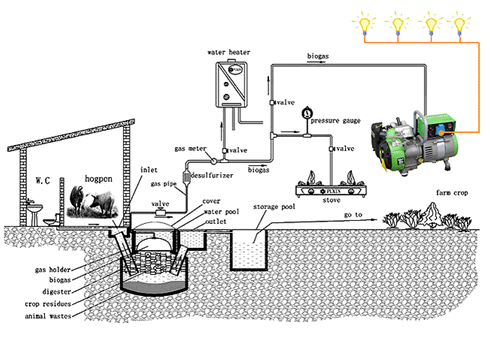
Before being injected in the gas grid, biogas passes a cleaning process, during which it is upgraded to natural gas quality. During the cleaning process trace components harmful to the gas grid and the final users are removed. Biogas in transport. Simple sketch of household biogas plant Depending on size and location, a typical brick made fixed dome biogas plant can be installed at the yard of a rural household with the investment between US$300 to $500 in Asian countries and up to $1400 in the African context. A high quality biogas plant needs minimum maintenance costs and can produce gas for at least 15–20 years without major problems and re-investments. For the user, biogas provides clean cooking energy, reduces indoor air pollution, and reduces the time needed for traditional biomass collection, especially for women and children.
The slurry is a clean organic fertilizer that potentially increases agricultural productivity. Domestic biogas technology is a proven and established technology in many parts of the world, especially Asia. Several countries in this region have embarked on large-scale programmes on domestic biogas, such as China and India. The, SNV, supports national programmes on domestic biogas that aim to establish commercial-viable domestic biogas sectors in which local companies market, install and service biogas plants for households.
In Asia, is working in Nepal, Vietnam, Bangladesh, Bhutan, Cambodia, Lao PDR, Pakistan and Indonesia, and in Africa; Rwanda, Senegal, Burkina Faso, Ethiopia, Tanzania, Uganda, Kenya, Benin and Cameroon. In South Africa a prebuilt Biogas system is manufactured and sold. One key feature is that installation requires less skill and is quicker to install as the digester tank is premade plastic.
Associations. American Biogas Council. Canadian Biogas Association. European Biogas Association.
Biogas Production Process Steps Pdf
German Biogas Association. Indian Biogas Association Society and culture In the 1985 Australian film the post-apocalyptic settlement Barter town is powered by a central biogas system based upon a piggery. As well as providing electricity, methane is used to power Barter's vehicles. 'Cow Town', written in the early 1940s, discuss the travails of a city vastly built on cow manure and the hardships brought upon by the resulting methane biogas.

Carter McCormick, an engineer from a town outside the city, is sent in to figure out a way to utilize this gas to help power, rather than suffocate, the city. The Biogas production is providing nowadays new opportunities for skilled employment, drawing on the development of new technologies. See also.